
Performing inspections, lubrication, and component replacements within an aircraft’s wheel well is one of the most physically demanding tasks in aviation MRO (Maintenance, Repair, and Overhaul). The confined spaces, intricate hydraulic lines, and height variations create a high-risk environment for technicians.
Using generic ladders or makeshift scaffolding in these zones is not only inefficient but also a severe violation of aviation workplace safety standards. To ensure absolute safety and operational efficiency, modern MRO facilities must utilize purpose-built landing gear maintenance platforms.
Whether you are servicing a narrow-body commuter or a massive wide-body freighter, here are the top engineering and safety requirements your ground support equipment (GSE) must meet.
1. Precision Contouring for Zero-Gap Skin Protection
The most critical requirement for any aviation access stand is preventing accidental damage to the aircraft’s fuselage. Aircraft skin, especially modern composite materials, is highly sensitive to impact.
A professional maintenance stand must feature precision contouring. This means the working deck and safety guardrails are 3D-engineered to mimic the exact geometry of the specific aircraft’s landing gear struts and tires.
- Rubber Bumpers: All leading edges approaching the aircraft must be wrapped in high-density, industrial-grade rubber padding.
- Zero-Gap Interface: The platform should fit intimately close to the maintenance points, eliminating dangerous gaps where tools could be dropped or technicians could slip.
2. Distinct Engineering for Narrow vs. Wide-Body Fleets
Aircraft size dictates fundamentally different structural requirements for access equipment. A “one-size-fits-all” approach poses significant safety hazards.
Narrow-Body Maintenance Demands (e.g., A320, B737)
For narrow-body aircraft, the primary challenge is operating within a highly compact footprint. Technicians need equipment that is agile enough to be maneuvered around tight tarmac spaces but rigid enough to prevent wobbling. For instance, when teams are working inside the confined Airbus wheel well, utilizing a precision-engineered A320 landing gear stand ensures that two technicians can comfortably execute lubrication routines with their tooling without feeling any structural sway.
Wide-Body Maintenance Demands (e.g., B787, A330, A350)
Wide-body aircraft present a different set of challenges: immense height and the need for heavy-duty payload capacities. Overhauling a massive main landing gear strut often requires multiple mechanics and heavy diagnostic or lifting equipment on the deck simultaneously. Safely navigating these expansive wheel wells requires a robust Boeing 787 landing gear platform that boasts a verified Safe Working Load (SWL) of 500 kg or more, supported by high-tensile structural steel.
3. Advanced Stabilization and Anti-Tipping Mechanisms
MRO environments are dynamic. Platforms are constantly towed, pushed, and parked on uneven hangar floors or sloped tarmac surfaces. Therefore, superior static stability is a non-negotiable OSHA and CE requirement.
While heavy-duty swivel casters provide necessary mobility, the equipment must possess a reliable anchoring system once in position. Standard mechanical brakes on casters are often insufficient for heavy-duty wide-body stands.
The Innovation in Stabilization: To achieve ultimate static stability, industry-leading GSE manufacturers integrate advanced leveling feet. For example, KiyeMech’s custom platforms utilize a proprietary lifting and support technology protected by a Mechanical Screw Jack Mechanism (Patent Number: ZL 2021 2 2443945.9 / CN216471985U). This patented design ensures that the load-bearing screw rod elevates strictly vertically without rotating. By eliminating rotational friction, the platform completely prevents shifting or twisting under heavy loads, ensuring the stand remains perfectly anchored and level, regardless of ground conditions.
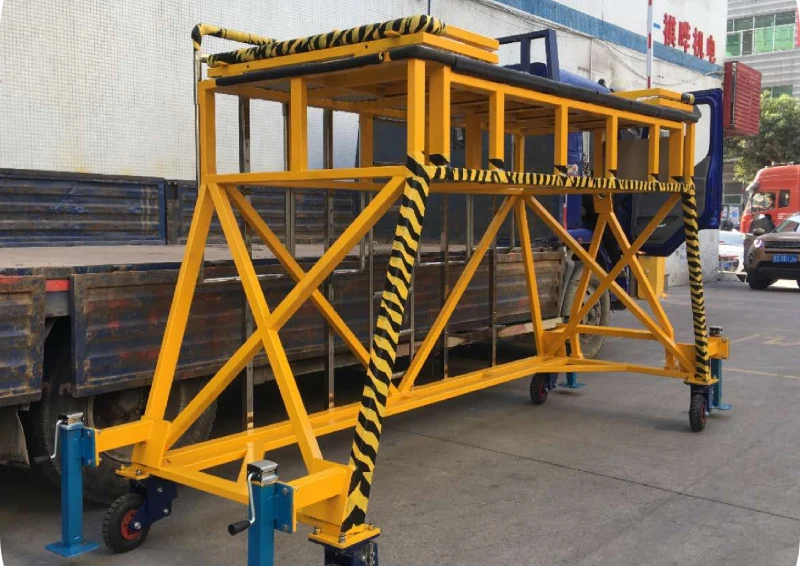
4. Uncompromising Fall Protection and Ergonomics
Working at heights ranging from 1.5 to over 2.5 meters requires strict fall protection systems. Essential ergonomic and safety features include:
- Industrial Anti-Slip Grating: Steps and main working decks must utilize high-grip, self-draining grating to prevent slips caused by hydraulic fluid or oil spills.
- Continuous Guardrails: Safety rails must be positioned at optimal ergonomic heights, providing a secure perimeter without restricting the technician’s access to the wheel well components.
5. Partnering with a Direct Custom GSE Manufacturer
Because hangar layouts and fleet compositions (such as mixed fleets of B737s, A330s, and A350s) vary dramatically across airlines, purchasing standard, off-the-shelf equipment often leads to operational compromises.
Leading MROs prefer to source their equipment directly from vertically integrated manufacturers. Working with a direct ISO 9001:2015 certified manufacturer like KiyeMech allows engineering teams to collaborate on custom 3D CAD designs. Whether you need a specific deck height for an A350, modified towing hitches for a B737 fleet, or specific anti-collision configurations, factory-direct customization ensures your equipment aligns perfectly with your facility’s exact safety protocols.
Elevate Your MRO Safety Standards
Investing in aircraft-specific landing gear maintenance platforms is an investment in both personnel safety and maintenance efficiency. By eliminating fall risks and airframe damage, specialized GSE directly contributes to faster turnaround times.
If your facility is looking to upgrade its access equipment for narrow or wide-body fleets, contact KiyeMech’s engineering team today to discuss custom structural solutions and request a factory-direct proposal.